

Overview
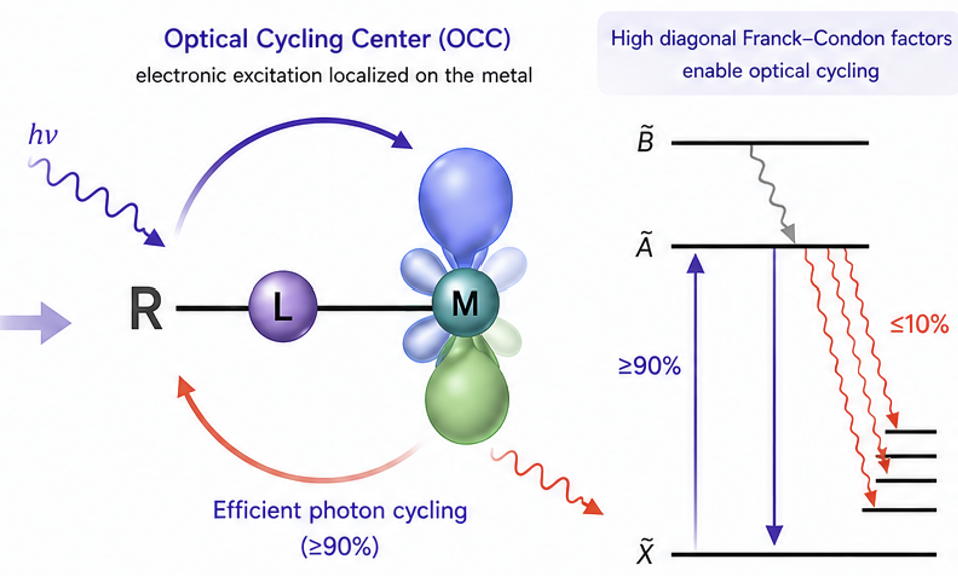
Optical control, the ability to prepare, manipulate, and read out quantum states using light, has driven transformative advances in atomic physics and quantum technology. Recent progress has extended this capability to a small number of simple molecules, such as CaF and CaOH. However, extending it to chemically complex molecular systems, where the richness of chemical design becomes available alongside optical precision, remains an open scientific challenge. Our research addresses this challenge through the design and study of optical cycling molecules. These molecules contain optical cycling centers (OCCs), where electronic excitation is spatially localized at a metal–ligand center. This localization reduces the coupling between electronic excitation and vibrational motion, enabling repeated photon scattering with minimal branching into dark vibrational states. While optical cycling molecules were first developed for laser cooling, their ability to scatter photons efficiently also provides a broader platform for optical readout and control. We aim to understand what structural and electronic principles enable efficient optical cycling, and how these principles can be engineered, extended, and deployed for spectroscopy, precision measurement, and molecular quantum science.
Research Direction 01
The chemical rules that govern when and why efficient optical cycling emerges (and breaks down) remain largely unexplored. Our lab focuses on identifying these underlying rules and testing how they evolve with molecular structure, including symmetry, charge, chirality, and the number of OCCs. We design and spectroscopically characterize new families of optical cycling molecules using cryogenic molecular beam methods and laser spectroscopy. The goal is to move beyond discovering individual laser-coolable molecules toward a general chemical framework for designing optically controllable molecular systems.
Research Direction 02
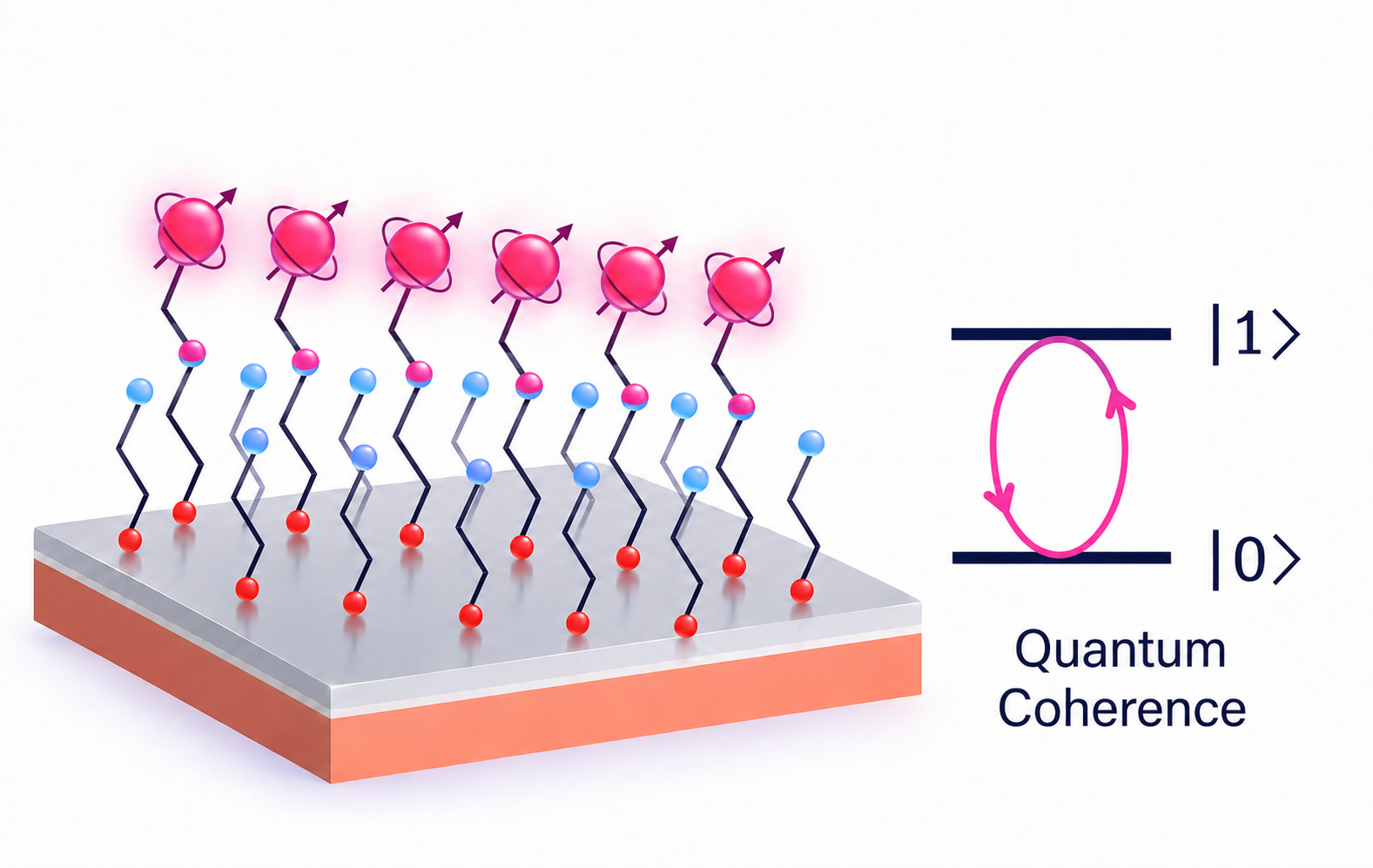
Molecules carry rich internal structure, including electron spin, nuclear spin, vibrational, and rotational degrees of freedom. If these states can be efficiently prepared, manipulated, and read out with light, molecules could become chemically tunable platforms for quantum sensing and control. OCCs provide a promising optical interface because they can scatter photons efficiently while being embedded within diverse molecular architectures. The key challenge is to combine this optical addressability with long-lived internal states, and to retain both properties in the complex environments where quantum devices operate. Our research investigates how these properties evolve in complex environments such as cryogenic matrices and surfaces, and how molecular design can be used to preserve, control, and exploit them for quantum sensing and control applications.